


Introduction
Luxury watches represent craftsmanship, personal style, and often a meaningful investment. However, an automatic watch can stop after sitting unused for several days, forcing the owner to reset the time, date, or complex calendar features. Luxury Watch Winders offer a convenient solution by keeping compatible watches gently moving while they are off the wrist. They are especially useful for collectors who rotate several timepieces or own moon-phase, annual-calendar, or perpetual-calendar watches. Yet a winder is not essential for every owner, and incorrect settings can reduce its value. This guide explains how these devices work, when they are useful, what features matter, and how to operate them responsibly.
What Is a Watch Winder?
A watch winder is a powered holder that slowly rotates an automatic watch. This movement copies wrist motion and causes the internal rotor to wind the mainspring. Luxury Watch Winders do not repair watches or improve accuracy; they simply help compatible automatic models remain powered.
A winder is suitable only for self-winding mechanical watches:
- Automatic watches may benefit from controlled rotation.
- Manual-wind watches still need winding by hand.
- Quartz, solar, and smartwatches receive no benefit from rotation.
Who Should Use One?
Luxury Watch Winders are most useful for collectors who switch between several automatic watches. They also help when a watch has complex calendar settings that take time to correct after the movement stops. Someone who wears one automatic watch every day may not need a winder. Daily wrist movement usually keeps it running.
| Watch or Owner Type | Winder Value | Main Reason |
| One daily automatic watch | Low | Wrist movement keeps it powered |
| Several automatic watches | High | Unused watches stay ready |
| Complex calendar watch | High | Avoids difficult resetting |
| Manual or quartz watch | None | Rotation cannot wind it |
| Vintage automatic watch | Ask a watchmaker | Older parts may need special care |
Main Benefits and Limits
The greatest advantage is convenience. Luxury Watch Winders keep selected watches ready to wear and reduce repeated adjustments. A covered model can also protect a collection from dust. However, a winder cannot fix poor timekeeping, worn parts, water-resistance problems, or movement damage. Owners should avoid unnecessary rotation.
Important points include
- Use the lowest suitable turns-per-day setting.
- Do not treat a display lock as a strong safe.
- Continue normal servicing and water-resistance checks.
- Ask a watchmaker before winding a fragile vintage model.
Understand TPD and Winding Direction
Before buying luxury watch winders, identify the movement inside each watch. Different movements may require different directions and numbers of turns. TPD means “turns per day.” Some movements wind clockwise, others counterclockwise, and many support both. Adjustable controls are safer than a fixed setting.
| Feature | Why It Matters | Good Choice |
| Adjustable TPD | Matches the movement | Several TPD levels |
| Direction control | Supports different calibers | Clockwise, counterclockwise, and both |
| Rest cycles | Avoids constant movement | Timed rotation with pauses |
| Separate controls | Helps mixed collections | Individual holder settings |
Choose the Right Size and Capacity
Luxury Watch Winders must hold watches securely without stretching straps or bracelets. A cushion that is too large may pressure the band, while one that is too small may let the watch move. Measure the case, bracelet, thickness, and weight before ordering. Multi-watch models should also leave enough space between cases.
Consider these factors
- Number of watches owned now.
- Expected collection growth.
- Watch diameter, thickness, and weight.
- Cushion size and softness.
- Separate settings for different movements.
Check Motor Quality, Noise, and Power
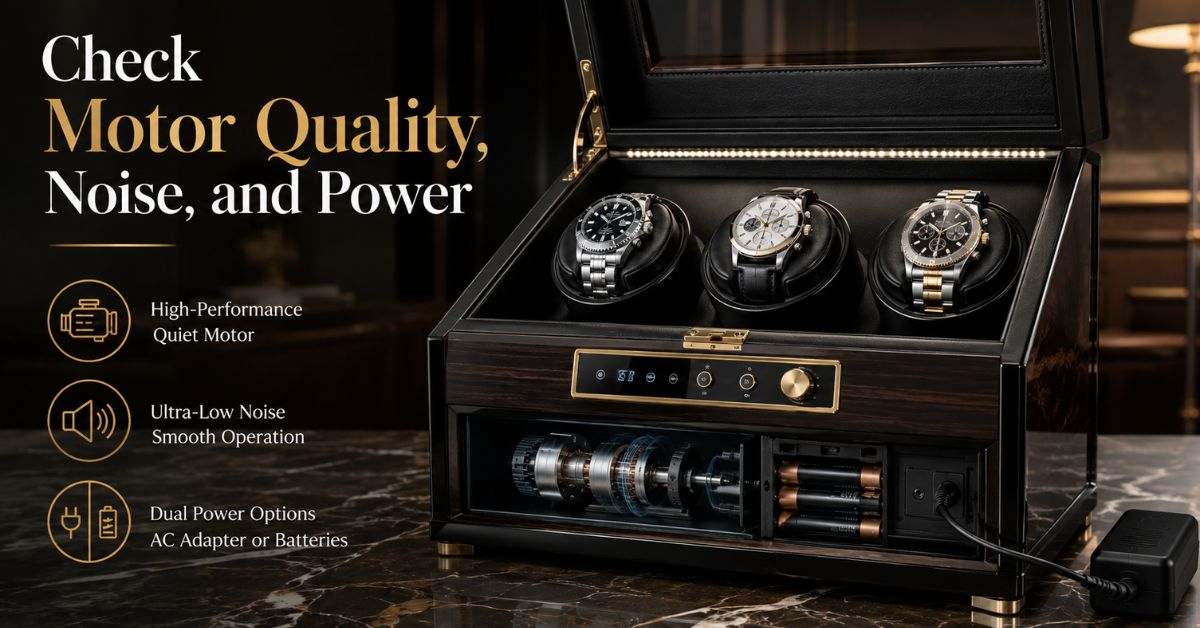
A smooth motor is one of the most important parts of luxury watch winders. Poor motors may become noisy, rotate unevenly, or fail early. For a bedroom or study, read owner feedback because “silent” does not always mean inaudible. Mains-powered models suit permanent use, while battery models work well inside cabinets or safes. A clear warranty is also important because motor repairs can be costly.
Think About Security
Many luxury watch winders have glass doors and small locks. These may stop casual handling, but they do not offer the protection of a tested watch safe. Owners of valuable collections should keep photographs and serial numbers, use suitable insurance, avoid obvious storage locations, and consider a strong safe or alarm system. The device should organize and display watches, but it should not be treated as complete protection against theft.
How to Set Up a Winder Correctly
A correct setup allows luxury watch winders to work without adding unnecessary movement. First, confirm the recommended TPD and rotation direction. If the watch has stopped, follow its manual for safe hand-winding.
Use this process
- Set the correct time, date, and complications.
- Close the crown fully.
- Place the watch firmly around the cushion.
- Choose the correct direction and the lowest suitable TPD.
- Examine the watch after 24 to 48 hours.
- Change only one setting at a time.
If the watch stops, increase the setting slowly rather than moving straight to the highest level. This makes it easier to identify the lowest effective program.
Common Mistakes to Avoid
A common mistake is choosing the highest TPD because it appears more effective. Luxury Watch Winders should match the movement rather than rotate as much as possible. Another mistake is using the same program for every watch. Owners should also avoid placing the unit near heat, moisture, direct sunlight, or magnetic equipment.
Other common errors include
- Putting a loose watch on the cushion.
- Using the device as a fast charger.
- Ignoring clicking or grinding sounds.
- Assuming an inaccurate watch only needs more rotation.
A watch that continues losing time may need professional inspection. Extra rotation cannot correct worn or damaged movement parts.
Cleaning and Long-Term Care
Luxury Watch Winders should sit on a dry, level, and stable surface. Clean the outside with a soft cloth and follow the maker’s instructions for wood, leather, glass, metal, or fabric. Inspect cushions, cables, hinges, battery areas, and rotating holders every few months. Uneven motion or new motor noise may show that maintenance is needed. The watches still require professional servicing and careful crown use. Owners should also check water resistance when recommended, especially before swimming or exposing a watch to moisture.
FAQs
Can a winder damage an automatic watch?
A reliable unit with correct settings is generally safe for a compatible modern automatic watch.
Should a winder run continuously?
No. It should rotate in planned cycles and rest between them.
How many turns per day should I use?
The correct number depends on the movement, so check the manufacturer’s guidance.
Can a Rolex use a winder?
Yes, but settings should match the exact watch reference and movement.
Are luxury watch winders worth the cost?
They are useful for collectors, complicated watches, and owners who often rotate automatic timepieces.
Conclusion
Luxury Watch Winders can make automatic watch ownership easier, but they should be selected for function rather than appearance. The right model keeps a compatible watch running, reduces repeated calendar adjustments, and provides organized storage. The wrong one may create poor fit, extra noise, unnecessary rotation, or weak security. Before purchasing, identify every watch movement and confirm its direction and TPD requirements. Then compare motor quality, cushion fit, capacity, power options, warranty, and security. Begin with the lowest recommended setting and observe the watch for one or two days. Well-chosen luxury watch winders support responsible ownership but do not replace professional care. Choose carefully, maintain the device, and continue regular servicing to protect your collection for years.